The Domino Effect That Ignited World War I
What began as a single political assassination became a continent-wide catastrophe because each decision triggered the next. The crisis moved like falling dominoes: deliberate, rapid, and nearly impossible to stop once it started.
Dominoes in Motion
6 stepsA Spark in Sarajevo
On June 28, 1914, Archduke Franz Ferdinand was assassinated. A localized crisis suddenly demanded a response.
The Ultimatum
Austria-Hungary issued a harsh ultimatum to Serbia, designed to be accepted only in part and justify action.
Alliance Wiring
Russia pledged support to Serbia; Germany backed Austria-Hungary. The regional dispute was now tied to great-power commitments.
Mobilization Trap
Once Russia mobilized, Germany followed. Timetables and war plans accelerated events faster than diplomacy could slow them.
Belgium Breached
Germany executed the Schlieffen Plan by invading Belgium, pulling Britain into the conflict to defend Belgian neutrality.
A Continental War
Declarations of war cascaded across Europe. A crisis that might have been contained became a world war.
Why the Dominoes Fell
The assassination was only the first tile. Deep structural tensions ensured that each move narrowed options, turning choices into obligations.
Nationalism
Rival ethnic and imperial ambitions made compromise look like surrender.
Alliance Commitments
Defensive pacts turned a bilateral dispute into a multi-power obligation.
Militarization
War plans and mobilization schedules created a built-in momentum for escalation.
Miscalculation
Leaders believed limited war was possible, underestimating the chain reaction.
The Point of No Return
Once mobilization began, war plans left little room for diplomacy. Railway schedules and military timetables turned political decisions into automatic escalation.
The crisis moved from a regional conflict to a global war in just over five weeks.
Infographic: The Chain Reaction
visual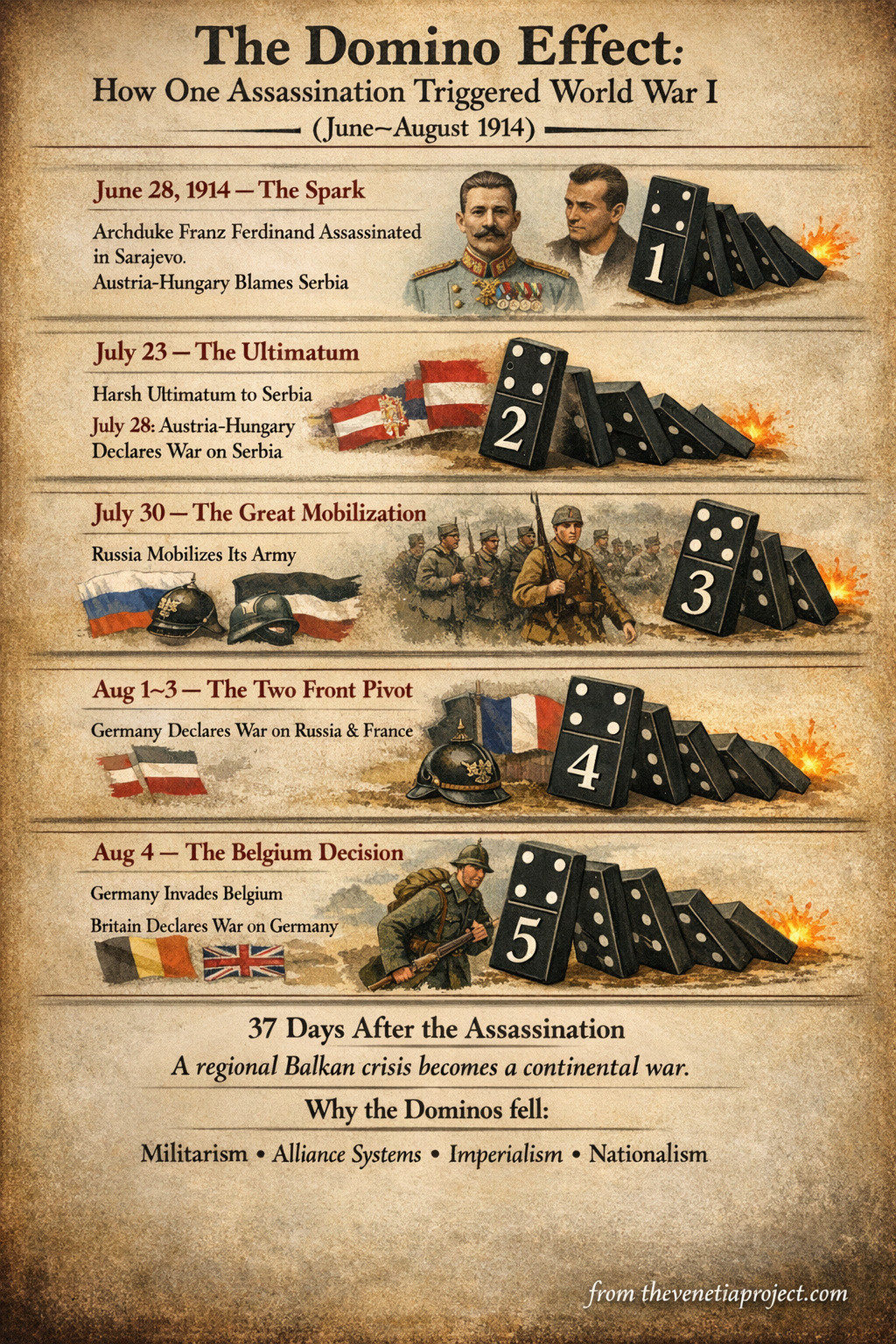
Source: Venetia Archives
From Spark to Conflagration
The domino metaphor shows why the crisis was so hard to stop. Each move limited the next options, turning diplomacy into reaction.
June 28
Assassination in Sarajevo creates a demand for punishment and an opportunity to assert power.
July 23-28
The ultimatum and its rejection activate alliance expectations and set mobilization in motion.
July 29-Aug 4
Mobilizations, declarations, and the invasion of Belgium transform the crisis into a world war.
Takeaway
The First World War did not begin with a single decision, but with a sequence of irreversible reactions across interconnected states.